


What Determines the Shelf Life of Agricultural Chemicals
The shelf life of Agricultural Chemicals is determined by formulation stability, storage temperature, packaging integrity, moisture exposure, and transportation conditions. For quality control and safety managers, understanding these factors is essential to maintaining product performance, regulatory compliance, and safe handling throughout international procurement and export supply chains.
For most buyers, shelf life is not simply the date printed on a container. It is the period during which a product remains safe, compliant, and fit for its intended agricultural use.
Quality control teams need evidence that the active ingredient, physical properties, packaging, and product label will remain acceptable until use. Safety managers also need assurance that deterioration will not create handling risks.
The most practical question is therefore not “How long does this chemical last?” but “Under which documented conditions will this specific formulation remain within specification?”
This article explains the variables that matter most, how they interact during international trade, and what inspection controls can reduce shelf-life-related disputes and safety exposure.
Why Shelf Life Is a Quality and Safety Control Issue
Shelf life is usually established through stability testing performed by the manufacturer. The result supports an expiry date, retest period, recommended storage conditions, and product release specifications.
For Agricultural Chemicals, a valid shelf-life claim depends on the product being stored in its original, unopened package under conditions defined by the manufacturer and applicable regulations.
A product may remain visually normal while losing active ingredient content, separating into phases, forming sediment, changing viscosity, or becoming more difficult to dilute and apply.
These changes can reduce field efficacy, cause equipment blockage, create inconsistent application rates, or lead to crop damage. They can also trigger customer complaints and costly replacement claims.
For safety teams, chemical ageing can affect container pressure, leakage probability, dust formation, vapor release, and compatibility with storage materials. These risks are especially relevant for hazardous cargo.
Shelf life also has commercial consequences. Overseas buyers may reject stock with insufficient remaining life, even when the product technically remains within the manufacturer’s stated expiry period.
Purchase contracts should therefore define the minimum residual shelf life required at shipment, arrival, or destination clearance. A vague “fresh production” requirement is often insufficient.
In practice, quality managers should treat expiry information as one part of a broader product assurance system involving formulation control, batch documentation, storage records, and transport verification.
Formulation Stability Is the Starting Point
The chemical structure of the active ingredient strongly influences shelf life. Some active substances are stable for years, while others degrade more readily through hydrolysis, oxidation, heat, or light exposure.
However, the active ingredient alone does not determine product durability. Agricultural formulations contain solvents, surfactants, emulsifiers, preservatives, carriers, dispersants, dyes, and other functional ingredients.
Each component can influence stability. A compatible active ingredient may still become commercially unsuitable when emulsifiers fail, solvents evaporate, or suspended particles settle into a hard compact layer.
Liquid formulations such as emulsifiable concentrates, suspension concentrates, soluble concentrates, and water-based products may face different physical stability risks from granules, powders, and water-dispersible products.
Suspension concentrates can settle during extended storage. Some settling is expected, but the product should redisperse adequately according to the applicable specification and recommended mixing procedure.
Emulsifiable concentrates may develop haze, crystals, color changes, or separation. These conditions can indicate temperature stress, solvent interaction, active ingredient precipitation, or formulation incompatibility.
Dry Agricultural Chemicals can absorb moisture, cake, lose flowability, or generate dust. Water-dispersible granules may become difficult to disperse when packaging barriers fail or humidity levels remain high.
Stability studies normally examine active content and relevant physical properties over time. Quality teams should request the product specification and understand which properties are critical for acceptance.
Temperature Has the Largest Operational Impact
Temperature is frequently the most important controllable factor affecting shelf life. Higher temperatures generally accelerate chemical reactions, solvent loss, physical separation, and degradation of sensitive formulation components.
Excessive heat can be encountered in warehouses, containers, port yards, inland vehicles, and destination storage areas. A chemical shipment may face very different temperatures before final delivery.
Many products are tested under accelerated storage conditions to predict longer-term behavior. That does not mean they can tolerate unlimited heat exposure during real-world storage or shipping.
Quality control staff should review the storage temperature range stated on the safety data sheet, technical data sheet, product label, and supplier stability documentation before placing an order.
High temperatures may increase internal pressure in sealed packaging, particularly where volatile solvents are present. This can contribute to bulging containers, cap leakage, or compromised closures.
Low temperatures can also damage Agricultural Chemicals. Freezing may break emulsions, cause crystallization, alter viscosity, or separate water-based products in ways that ordinary mixing cannot correct.
Temperature-sensitive products should not be routed solely by freight cost. Transit duration, seasonal weather, port dwell time, container exposure, and destination climate should influence logistics planning.
For critical shipments, temperature data loggers can provide useful evidence. They help buyers and suppliers determine whether a product issue resulted from manufacturing, storage, or transport conditions.
Packaging Integrity Protects the Formulation
Packaging is part of the shelf-life system, not merely a transport accessory. The selected container must protect the formulation from moisture, oxygen, light, contamination, and physical damage.
Container material must also be compatible with the chemical. Certain solvents, acids, alkalis, and oxidizing substances can weaken unsuitable plastics, coatings, seals, liners, or closures.
For liquid products, inspect container walls, cap threads, induction seals, gasket condition, and tamper-evident features. Small closure defects can cause gradual leakage or solvent evaporation.
For powders and granules, moisture-barrier performance is critical. Inner liners, heat seals, laminated bags, and pallet stretch wrapping can materially affect product condition during overseas transport.
Light-sensitive products may require opaque containers, ultraviolet-resistant packaging, or secondary cartons. Transparent packaging can shorten usable life when products are exposed to direct sunlight during storage.
Packaging performance should be assessed at both unit and pallet levels. A sound bottle can still become damaged when pallets are poorly stacked, insufficiently secured, or exposed to repeated vibration.
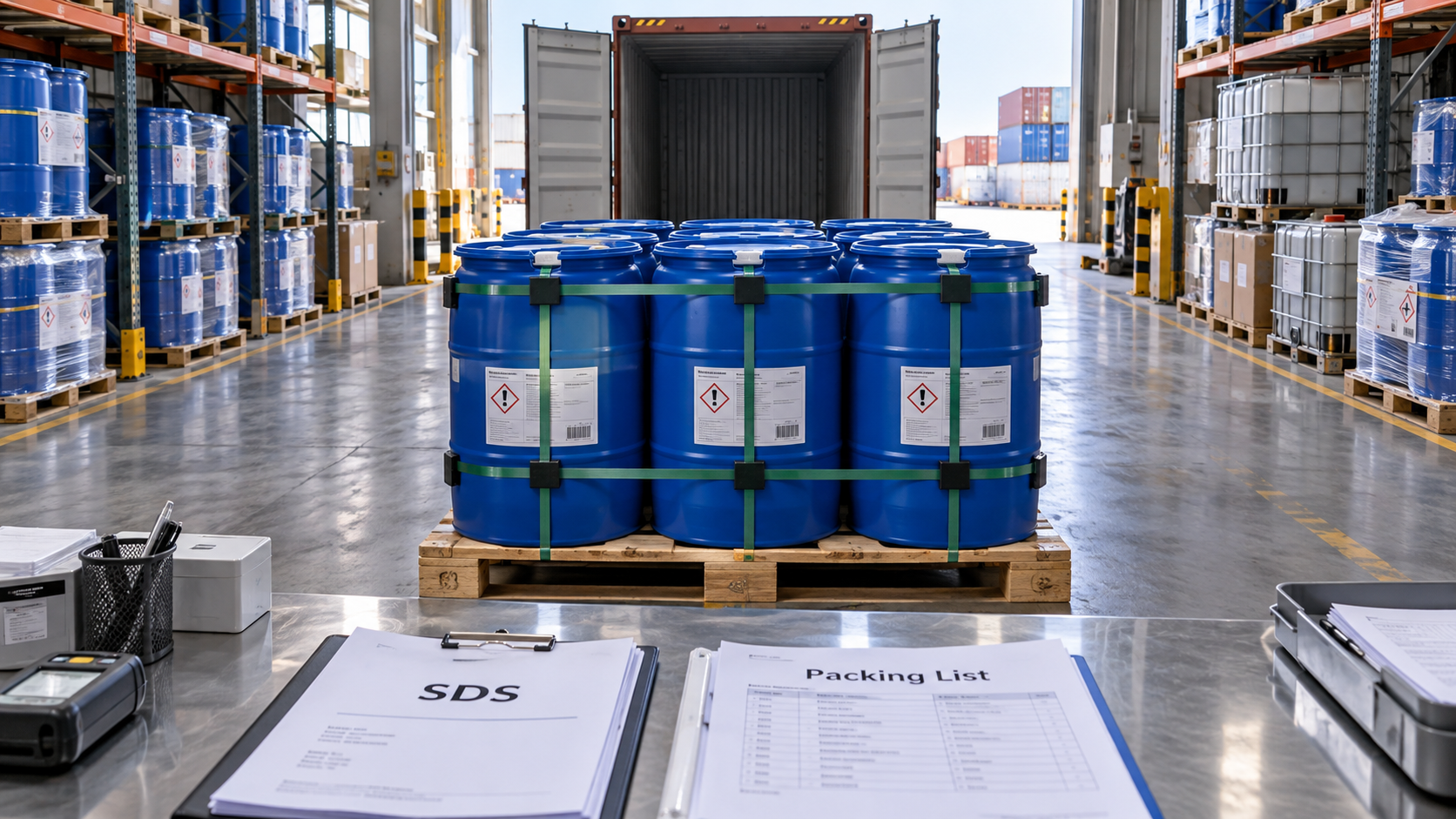
Before shipment, inspection records should confirm correct packaging type, net weight, lot number, manufacturing date, expiry date, labels, closure condition, and compliance marks where required.
When receiving goods, retain photographs of any wet cartons, distorted drums, leaking caps, collapsed bags, or mismatched labels. These records are valuable for root-cause investigation and claims management.
Moisture, Air, and Contamination Can Shorten Product Life
Moisture is a major risk for hygroscopic materials and water-reactive active ingredients. Even limited water ingress can lead to hydrolysis, caking, loss of flowability, or changes in concentration.
Humidity exposure often occurs through damaged packaging, poor warehouse conditions, container condensation, or loading operations during rain. It may not become visible until after destination arrival.
Container condensation, commonly called container rain, can damage outer cartons and moisture-sensitive bags during long ocean voyages. Proper desiccant use and cargo preparation can reduce this risk.
Air exposure can accelerate oxidation in certain formulations. Repeated opening of partially used containers may also introduce moisture, dirt, incompatible residues, or microbial contamination into susceptible products.
Quality procedures should distinguish between unopened stock and opened stock. The original shelf life may not apply after opening, particularly for water-based products or products transferred into secondary containers.
Secondary repacking requires particular caution. Unless authorized and properly controlled, repacking can compromise traceability, packaging compatibility, label compliance, and the validity of the original shelf-life declaration.
Warehouse segregation also matters. Agricultural Chemicals should be kept away from food, feed, ignition sources, incompatible chemicals, and areas where water leaks, dust, or direct sunlight are likely.
Good housekeeping supports product quality as well as workplace safety. Clean, dry storage areas make it easier to identify leakage, damaged packaging, pest activity, and unauthorized handling early.
Transportation Conditions Can Change the Remaining Shelf Life
International transportation does not automatically invalidate shelf life, but it can consume a meaningful portion of the usable period. This is especially relevant for long routes and seasonal extremes.
Ocean freight introduces vibration, temperature variation, humidity, port delays, transshipment risks, and extended container dwell time. These factors should be considered before production and shipping schedules are finalized.
Hazardous chemical exports require additional care. Proper classification, approved packaging, labeling, declarations, and stowage arrangements help protect both cargo integrity and regulatory compliance during transit.
Incorrect dangerous goods documentation can delay shipment release. A delay may expose products to unfavorable port conditions and leave buyers with less residual shelf life upon delivery.
For temperature-sensitive Agricultural Chemicals, the supplier and freight provider should discuss container selection, loading time, route risk, seasonal timing, and whether insulated or controlled transport is necessary.
Transit planning should include realistic contingency time. Quality teams should avoid allocating stock with marginal remaining life to routes prone to congestion, customs holds, transshipment, or difficult inland delivery.
Shipment documents should connect each batch to its production date and expiry date. This enables buyers to apply first-expired, first-out inventory practices after receipt and during local distribution.
A capable export partner can coordinate product details, dangerous goods documentation, packing arrangements, customs procedures, and shipping schedules, reducing avoidable shelf-life exposure across the supply chain.
How Quality Control Teams Should Assess Remaining Usable Life
Quality control should begin before purchase confirmation. Request a certificate of analysis, product specification, safety data sheet, technical data sheet, packaging details, and batch-level date information.
The certificate of analysis confirms released batch results, but it does not replace stability evidence. It should be evaluated alongside the declared shelf life and storage requirements.
Set a written residual shelf-life threshold based on expected transport time, customs clearance, local warehousing, distribution cycle, and planned application season. The threshold should be product-specific.
For example, a buyer may require at least twelve months remaining shelf life at destination arrival for a product intended for seasonal distribution through multiple regional warehouses.
Incoming inspection should verify packaging condition, labeling, lot identity, quantity, dates, and appearance. Where risk justifies it, conduct sampling and laboratory testing against agreed specifications.
Useful tests may include active ingredient assay, pH, viscosity, density, moisture, wet sieve residue, suspensibility, emulsion stability, dispersibility, particle size, or dissolution performance.
Testing requirements should reflect formulation type and risk. A generic inspection checklist may miss the characteristic failure modes of a specific herbicide, insecticide, fungicide, fertilizer, or adjuvant formulation.
Where a product is near expiry or exposed to abnormal conditions, do not rely only on visual inspection. Obtain technical assessment from the manufacturer and perform appropriate confirmatory testing.
What Safety Managers Need to Control in Storage
Safety managers should translate supplier storage instructions into site-level controls. This includes defined temperature limits, ventilation, segregation, spill preparedness, access control, and regular container inspection.
Inventory systems should record manufacturing dates, expiry dates, storage locations, and inspection status. First-expired, first-out rotation is generally more appropriate than simple first-in, first-out rotation.
Expired stock should be clearly identified and isolated pending technical evaluation or disposal. It should not be relabeled, blended, repacked, or issued for use without documented authorization.
Do not assume an expired product is automatically unsafe, or that it remains effective. Expiry indicates that the manufacturer no longer guarantees conformity under stated storage conditions beyond that date.
Safety teams should establish escalation criteria for leakage, swollen drums, unusual odors, crystallization, severe separation, damaged labels, heat exposure, water exposure, or missing batch traceability.
Emergency plans should account for the actual chemical hazard, not only the product category. Current safety data sheets, correct personal protective equipment, and spill materials must remain available.
Periodic warehouse audits should examine rack loading, pallet condition, ventilation, temperature records, damaged packaging, segregation, drainage protection, and whether labels remain readable throughout storage.
Training should cover the reasons behind these controls. Staff are more likely to report early product changes when they understand how storage abuse can affect safety, efficacy, and legal compliance.
Choosing Suppliers With Shelf-Life Control Capability
Supplier selection should include more than price comparison. Buyers need confidence that the supplier can provide reliable batch information, suitable packaging, technical documents, and export logistics support.
Ask how the supplier controls production dates, manages warehouse temperature, performs pre-shipment inspection, and confirms packaging compatibility. These answers reveal whether shelf-life claims are operationally supported.
For international orders, confirm who prepares dangerous goods documents, verifies destination requirements, manages booking delays, and communicates changes that could affect transit conditions or delivery timing.
Jingrui Yake supports overseas chemical buyers through consolidated sourcing, export documentation, hazardous materials export procedures, customs coordination, and port logistics planning across multiple product categories.
For quality and safety managers, this type of support can improve traceability between supplier batches, shipping records, documents, and receiving inspections, particularly when sourcing from different manufacturing regions.
Before placing repeat orders, review prior shipment performance. Track residual shelf life on arrival, packaging damage rates, document accuracy, transit delays, complaint trends, and response times for technical questions.
These indicators create a more useful supplier assessment than unit price alone. A low-cost shipment can become expensive when insufficient shelf life, damaged packaging, or incomplete documentation interrupts distribution.
Conclusion: Shelf Life Must Be Managed Across the Supply Chain
The shelf life of Agricultural Chemicals is determined by formulation design, active ingredient stability, temperature, moisture, packaging, handling, and transportation conditions rather than by one isolated factor.
Quality control managers should define batch-specific acceptance criteria, verify residual shelf life before shipment, inspect incoming goods, and use testing when transport history or product condition raises concerns.
Safety managers should maintain controlled storage conditions, effective segregation, first-expired, first-out inventory rotation, clear escalation procedures, and disciplined handling of expired or damaged chemical products.
For international procurement, the strongest approach combines suitable product selection with reliable documentation, packaging verification, realistic transit planning, and supply chain partners experienced in chemical export requirements.
When these controls are applied consistently, buyers can protect product performance, reduce safety incidents, support regulatory compliance, and ensure that Agricultural Chemicals reach end users with adequate usable life remaining.