
Latest News

Send Us A Message
Why Sodium Carboxymethyl Cellulose Forms Lumps and How to Prevent Them
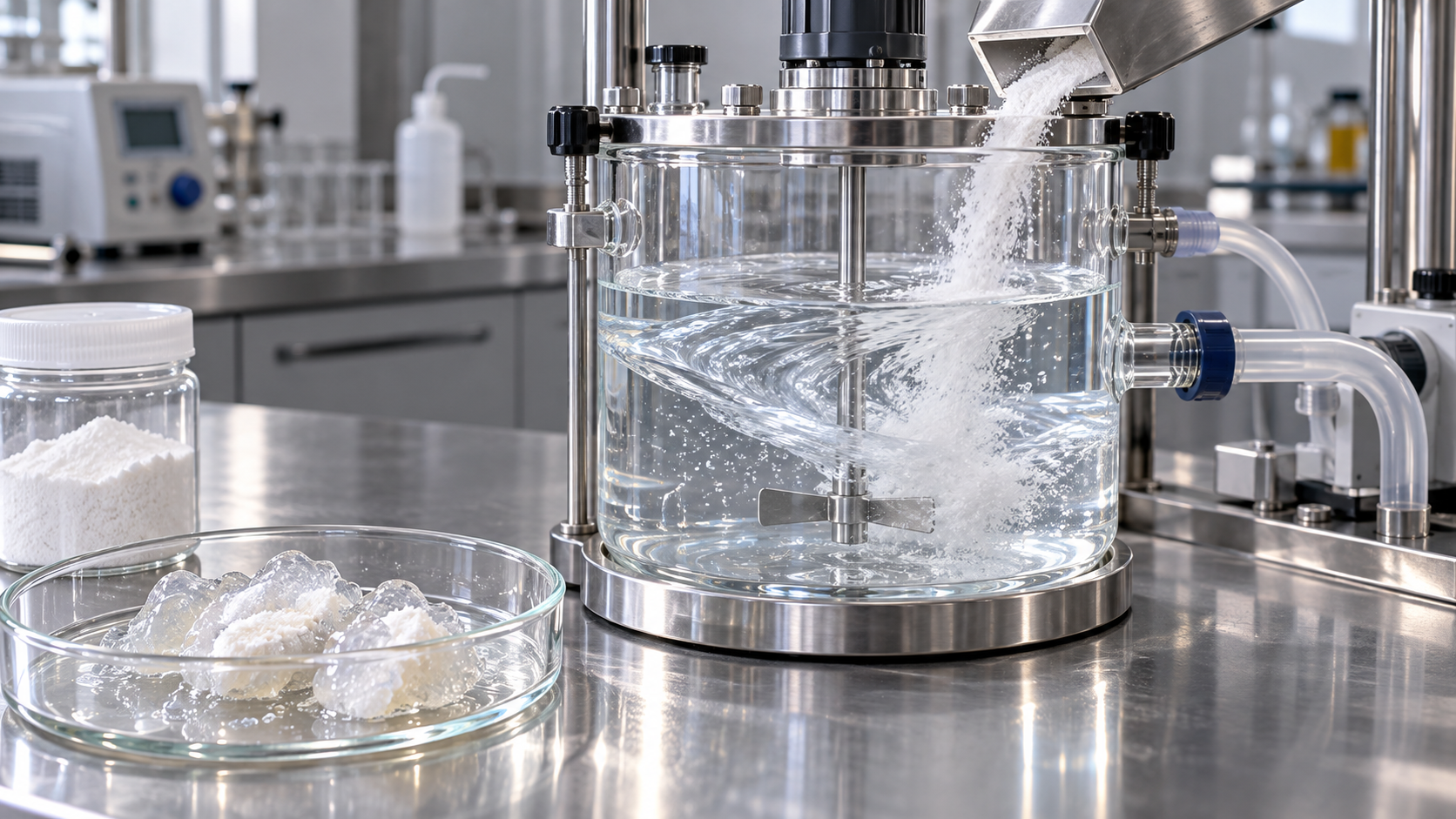
To prevent Sodium Carboxymethyl Cellulose (CMC) from forming lumps, spread the powder into moving water at a rate the mixer can disperse immediately, then allow sufficient time for hydration before adding ingredients that restrict it. When powder lands in a pile, the outside hydrates into a sticky gel while the center remains dry. Increasing mixer speed after these “fish eyes” have formed often leaves the protected cores intact.
Reliable preparation requires two separate stages: distributing individual particles through the liquid and allowing those particles to hydrate. A batch can look well mixed while still containing incompletely hydrated material. Keeping these stages distinct helps identify whether the problem comes from powder feeding, circulation, formulation chemistry, or insufficient holding time.
Read the lump before changing the process
A gelatinous particle with a white, powdery center is strong evidence of poor initial dispersion. Several particles contacted water together, and their hydrated surfaces joined into a shell. Larger agglomerates have a longer path for water penetration, so waiting alone becomes an inefficient remedy.
Other defects require different responses. Soft, uniformly swollen particles without dry centers suggest that hydration is progressing but remains incomplete. Grit that persists after adequate hydration deserves investigation for foreign material, insoluble matter, or incompatibility with another ingredient. Sudden flocculation after an acid or salt addition points toward a formulation interaction rather than the original powder-feeding step.
Inspect a representative sample outside the vessel. Spreading a small amount between suitable transparent surfaces makes dry centers easier to distinguish from bubbles or swollen gel. Follow the material-handling requirements for the formulation, and never reach into operating mixing equipment.
Control what happens where powder meets water
The most important mixing condition is local: fresh powder must leave the wetting zone before more powder covers it. A vessel can show vigorous motion while the surface contains slow-moving areas where powder accumulates. Dumping a bag into such an area overwhelms dispersion even when the average batch concentration is low.
Introduce powder as a thin, controlled stream into a well-circulated region. Avoid the vessel wall, shaft, and exposed fittings, where damp deposits can build up and later fall into the batch as lumps. If floating powder forms a persistent raft, pause the feed until it clears. Continuing to add powder makes the submerged gel mass harder to break apart.
A deep vortex is not a reliable measure of effective dispersion. It can draw in air while leaving circulation near the vessel bottom inadequate. Adjust impeller position, liquid depth, and baffling where the equipment design permits. The goal is continuous movement through the powder-entry region and throughout the vessel.
As hydration proceeds, viscosity rises and circulation changes. A feed rate that worked at the start may become excessive later. Watch for powder lingering on the surface, slower turnover, and stagnant regions. These observations provide a more useful feeding limit than a fixed bag-emptying time.
Why mixer speed alone is misleading
Rotational speed does not describe the complete mixing action. Impeller diameter, geometry, clearance, vessel shape, and changing viscosity determine whether the mixer disperses powder or merely moves a thick mass around the shaft. Copying the same speed from a laboratory vessel to a production tank therefore does not reproduce the same wetting conditions.
High-shear equipment is useful for rapid initial dispersion when it receives enough liquid and powder enters at a controlled rate. However, a rotor-stator mixer cannot correct poor circulation elsewhere in the tank. Prolonged aggressive processing also introduces heat and air, and under sufficiently severe conditions can reduce polymer viscosity. Use the intensity needed to disperse the powder, then maintain circulation appropriate for hydration.
Choose an introduction method that fits the formula
Direct addition works well when the vessel has enough low-viscosity liquid to separate the incoming particles. Start circulation before feeding and introduce CMC before other ingredients make the liquid difficult to mix. Reserving too little water for this stage creates a concentrated intermediate that becomes unmanageable before all the powder has entered.
Where direct addition remains unreliable, two alternatives can improve particle separation:
- Dry blending with a compatible powder. A suitable soluble ingredient, such as sugar in an appropriate formulation, physically separates CMC particles before they reach water. The blend must be uniform, and the carrier quantity must be sufficient to prevent CMC-rich pockets. A token addition provides little protection.
- Prewetting in a compatible nonsolvent. A liquid such as glycerol, where permitted by the formulation, can separate particles before the slurry enters water. Water content in the prewetting liquid matters: premature hydration can turn the slurry into a paste. Confirm the medium, proportion, and addition method through a small-scale trial.
These methods must fit the final composition. A carrier that changes solids content, taste, drying behavior, or downstream performance creates a separate formulation problem. Prepare prewetted slurries consistently and control their holding conditions; do not assume a slurry remains equally easy to disperse after extended storage.
Powder-induction equipment offers another route by bringing powder directly into a moving liquid stream. Its performance depends on liquid flow, suction conditions, and viscosity. Once circulation becomes restricted, forcing more powder through the inlet can produce concentrated deposits inside the system.
Water chemistry and addition order can change the result
Use water of known, consistent quality when establishing the preparation method. Dissolved salts affect polymer behavior, and hardness introduces multivalent ions that can interfere with some grades or formulations. The severity depends on ion concentration, CMC characteristics, and the rest of the recipe. Water that works for one application is not automatically suitable for another.
A simple comparison helps separate chemistry from mixing: prepare small batches using the same powder, concentration, temperature, and addition method, with production water in one and suitable low-mineral water in the other. A clear difference in hydration or appearance justifies investigating water composition before modifying the mixer.
Where the formulation permits, hydrate CMC in the least restrictive aqueous phase before introducing concentrated salts, acids, or high levels of other dissolved solids. Adding powder directly into brine or syrup combines difficult wetting with limited water availability. Adding acid locally can also expose the polymer to conditions much harsher than the measured final batch pH.
Strongly acidic conditions can reduce solubility by converting sodium carboxylate groups toward the less soluble acid form. Cationic ingredients can interact with anionic CMC and cause aggregation or precipitation. Such incompatibility will not be resolved by longer mixing. Test the intended composition and addition sequence before scaling up.
When later additions cause clumps, record where and how quickly they enter. Diluting a compatible ingredient before addition and feeding it into strong circulation can reduce local concentration extremes. This approach cannot make an inherently incompatible formulation stable.
Temperature and grade determine the hydration window
Heating is not a universal cure for lumping. Warmer water can accelerate hydration, but faster surface swelling can also make poorly dispersed powder seal over more quickly. Temperature changes both hydration kinetics and the viscosity observed during preparation, so an apparently thinner warm batch does not establish that dissolution is complete.
Begin with the temperature conditions recommended for the actual grade and validate adjustments against the process. Record temperature during powder addition and during the final viscosity measurement. Avoid adopting a hot-water procedure intended for a different cellulose ether; related materials do not necessarily share the same temperature-dependent behavior.
Grade selection also affects preparation. Fine particles offer a large wetting surface and can agglomerate quickly when fed poorly. Coarser particles generally require more time for water penetration. Agglomerated or surface-treated dispersible grades can change this balance, so particle size alone does not predict performance.
A higher-viscosity grade can cause the preparation liquid to thicken earlier, reducing the circulation available to disperse the remaining powder. Degree of substitution and its distribution influence solubility and tolerance to formulation conditions. A nominal viscosity value therefore cannot establish whether two grades will hydrate similarly in the same process.
When changing grades, compare dispersion behavior, hydration time, and final performance under the intended recipe. Confirm how the stated viscosity was measured, including concentration and temperature. Otherwise, a specification difference can be mistaken for a processing failure.
Recover an affected batch without hiding the cause
Stop powder addition as soon as persistent lumps appear. Continuing the charge increases the amount requiring recovery and often raises viscosity enough to weaken circulation further. Maintain controlled mixing while examining a sample to determine whether the material contains dry cores or simply needs more hydration time.
For incompletely hydrated material, a defined holding period with adequate circulation may be sufficient. For fish eyes, recovery requires exposing the dry interior. Suitable recirculation or dispersing equipment can help, provided the batch remains within its temperature, aeration, and shear limits. Follow the equipment’s operating requirements and avoid repeatedly processing the batch without checking whether the lumps are actually shrinking.
Additional water can improve mobility and hydration only when the formulation allows it. Any dilution must be reflected in the final mass balance. Adding extra CMC to compensate for an initially low viscosity is particularly risky: existing particles may hydrate later and push the finished batch above its target.
Filtration removes agglomerates rather than dissolving them. It can also remove part of the intended polymer dose, leaving an apparently cleaner batch with altered performance. If filtration is used, assess the retained material and verify the finished composition and properties before release.
Define completion with repeatable observations
A smooth surface does not establish complete hydration. Take representative samples after adequate vessel turnover, inspect for gel particles, and measure viscosity using a consistent method. Control sample temperature, concentration, measurement settings, and the interval between sampling and testing. Entrained air can distort appearance and measurement, so use a consistent deaeration procedure where necessary.
Compare measurements taken after successive defined hydration intervals. A stable result, together with the absence of dry cores and acceptable residue, supports completion more strongly than elapsed mixing time alone. Record the powder grade, water source, addition duration, temperature, and mixing conditions so the successful batch becomes a reproducible preparation procedure.
Send Us Your Inquiry Today