
Latest News


Send Us A Message
Polyethylene Glycol Molecular Weight: Effects on Viscosity and Solubility
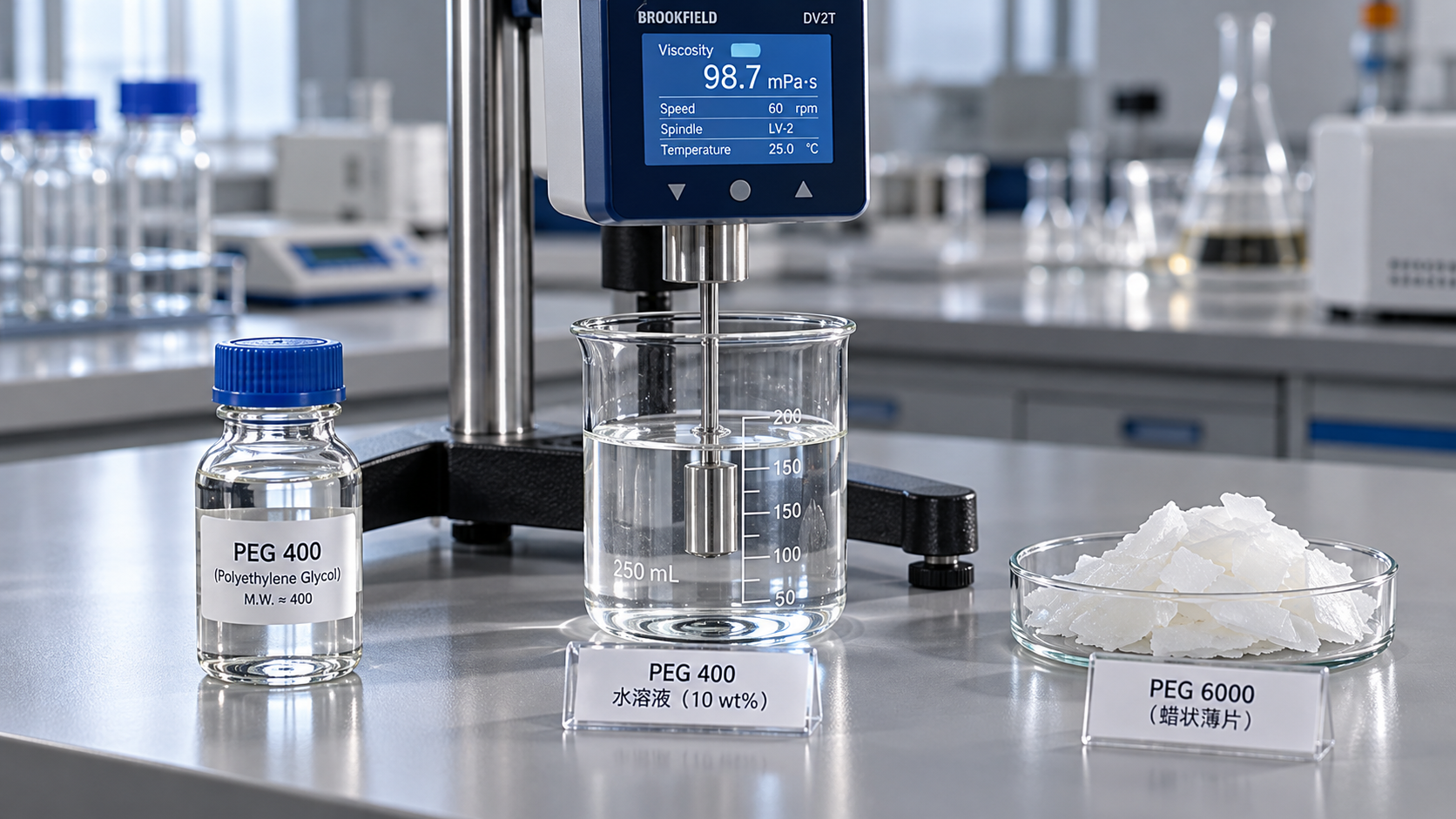
Increasing the molecular weight of Polyethylene Glycol generally raises its viscosity and shifts its physical form from a liquid toward a waxy or solid material at room temperature. In aqueous formulations, a higher molecular weight also generally produces greater viscosity when concentration and temperature are held constant. These relationships make molecular weight a useful starting point for grade selection, but they do not predict how quickly a grade will dissolve or whether a finished formulation will remain homogeneous.
For technical evaluation, three questions deserve separate answers: how the neat material behaves during handling, what viscosity it produces in the formulation, and whether it dissolves and remains dissolved under the intended conditions. A higher-molecular-weight grade can dissolve slowly while still being suitable for a water-based formulation. A lower-molecular-weight grade can be easy to pour yet provide insufficient viscosity or change the solvent balance of the product.
What a PEG molecular-weight designation actually tells you
PEG consists of repeating oxyethylene units, usually with hydroxyl groups at both ends. Commercial grades contain chains of different lengths, so their molecular-weight designations describe an average rather than a single molecular species. Familiar labels such as PEG 400 and PEG 6000 identify substantially different chain-length ranges, but the number alone is not a complete specification.
Comparisons require attention to how that average is defined and measured. Number-average molecular weight, weight-average molecular weight, and an average inferred from hydroxyl value describe different aspects of a molecular-weight distribution. Values obtained by different methods should not be treated as interchangeable without checking their basis. Even materials with similar reported averages can differ in viscosity when their distributions differ.
The grade designation also does not specify moisture, additives, or the physical form supplied. These factors matter when comparing samples or interpreting a certificate of analysis. For a meaningful evaluation, read the molecular-weight range together with the viscosity specification, water content, and melting or freezing characteristics. Each describes a different part of the material’s behavior.
Why molecular weight changes viscosity—and why conditions can outweigh the grade number
Longer PEG chains occupy a greater hydrodynamic volume in solution and encounter more resistance as they move past surrounding molecules. As concentration increases, interactions between chains become more important. At sufficiently high chain length and concentration, chain overlap and entanglement can contribute strongly to flow resistance. Consequently, doubling molecular weight does not imply a simple doubling of formulation viscosity.
Any viscosity comparison needs a defined concentration, temperature, and measurement method. A value for neat liquid PEG cannot be compared directly with a value for an aqueous solution of solid PEG. Nor can two aqueous values be interpreted confidently if one solution contains more polymer or was measured at a lower temperature. Technical data sheets may report different sample conditions for different grades.
Concentration deserves particular attention because its influence can become strongly nonlinear. A modest increase in solids may cause a disproportionately large viscosity increase once chains interact extensively. This affects mixing, pumping, filtration, and filling. Selecting a grade from a dilute-solution measurement can therefore give a misleading picture of a concentrated intermediate or finished product.
Temperature introduces another distinction. Warming a homogeneous PEG solution generally reduces its viscosity, while cooling increases resistance to flow. Solid grades may also require heating before their neat-material viscosity can be measured meaningfully. A viscosity value obtained above the melting range provides useful information for heated transfer, but it says little about whether that grade can be pumped from an unheated storage vessel.
Consider a formulation that must pass through a transfer line while warm and then be filled after cooling. A grade can perform adequately during transfer yet become too viscous at the filler. The relevant acceptance conditions should cover both stages. If the final product encounters colder storage or transport, its behavior there also belongs in the evaluation.
Units can create a further comparison error. Dynamic viscosity describes resistance to flow, while kinematic viscosity incorporates density. Values expressed in mPa·s and mm²/s are therefore not directly equivalent; conversion requires the sample density at the relevant temperature. For concentrated or complex formulations, the instrument geometry and measurement settings may also affect the reported result.
Many PEG solutions behave approximately as Newtonian liquids within an appropriate measurement range, but that assumption should not automatically extend to every finished formulation. Suspended solids, associative ingredients, or other polymers can introduce shear-dependent behavior. If pumping and application impose very different shear conditions, a single viscosity reading may not adequately describe performance.
Dissolution rate and equilibrium solubility answer different questions
Dissolution rate describes how quickly PEG enters solution. Equilibrium solubility describes how much can remain dissolved at a specified temperature and composition once equilibrium is reached. Confusing these properties can lead to rejecting a suitable grade because a short mixing trial leaves visible particles, or accepting an unsuitable formulation because heating temporarily produces a clear liquid.
Higher-molecular-weight solid PEG often takes longer to dissolve than a liquid grade because the process includes wetting and breaking down a solid structure before chains disperse into the liquid. Particle size, crystallinity, agitation, addition rate, and temperature all influence that process. Flakes, powders, and larger pieces of the same nominal grade can therefore produce different preparation times.
Rapid addition can create agglomerates with hydrated outer layers and incompletely dissolved interiors. These may resemble insoluble material even when the formulation can ultimately become homogeneous. Before attributing residue to poor solubility, examine the addition sequence and mixing conditions. More mixing time alone may be inefficient if circulation leaves material trapped in poorly mixed regions.
PEG has a strong affinity for water, and many commercial grades can form aqueous solutions over useful concentration ranges. Nevertheless, there is no reliable universal rule that each increase in molecular weight causes a proportional decrease in water solubility. Chain length, solid-state structure, temperature, concentration, and other dissolved ingredients all affect the observed behavior.
The balance becomes especially important in concentrated systems. Longer polymer chains have a smaller entropy-of-mixing contribution per unit mass, while crystalline solid PEG must also overcome the energetic requirements of leaving the solid phase. These effects help explain why a grade that dissolves readily in a dilute preparation may behave differently near a formulation’s concentration or temperature limits.
Heating can accelerate dissolution by improving molecular mobility and reducing viscosity. It can also melt solid PEG, depending on the conditions. However, clarity at the preparation temperature does not establish stability after cooling. Crystallization, haze, or phase separation may appear later, so the evaluation should include cooling to the lowest relevant use or storage temperature and observing the sample over an appropriate period.
Water quality and the rest of the formulation can change the result. Salts and other ingredients may alter PEG hydration and phase behavior. Some systems can develop clouding or separation as temperature changes. A dissolution test in deionized water establishes a useful baseline, but the final decision should use the actual solvent mixture, electrolyte content, and ingredient concentrations.
Solubility in organic solvents requires separate assessment. PEG’s behavior depends on the solvent’s polarity and hydrogen-bonding characteristics, as well as molecular weight and temperature. A grade’s compatibility with water cannot establish its compatibility with an alcohol-rich or mixed-solvent formulation. Even a clear initial blend may become unstable when another ingredient is added or solvent composition changes through evaporation.
How to compare grades without confusing the variables
A useful screening exercise starts with two or three grades that plausibly meet the application’s handling and viscosity requirements. Prepare them at the same mass fraction in the same liquid medium. Keep the addition procedure, mixing conditions, and temperature consistent. Record preparation time separately from final viscosity and appearance so that slow dissolution does not obscure otherwise acceptable performance.
When moisture differs between samples, distinguish the concentration calculated from the material as received from the concentration on a dry-polymer basis. This can matter in sensitive comparisons because an apparent viscosity difference may partly reflect a difference in actual polymer content. The calculation basis should remain consistent between laboratory trials and production instructions.
A compact evaluation record should capture:
- Material identity: grade designation, specified molecular-weight range, measurement basis, physical form, and water content.
- Preparation conditions: solvent composition, PEG mass fraction, addition order, mixing conditions, temperature, and time to a homogeneous sample.
- Viscosity conditions: measurement temperature, method, instrument settings where relevant, units, and sample conditioning.
- Behavior after preparation: clarity, remaining solids, crystallization, separation, and viscosity after relevant cooling or storage exposure.
Interpret the results against the process requirement. If two grades reach the required viscosity, the one that dissolves faster may simplify production. If a higher grade reaches that viscosity at a lower concentration, it may also change lubrication, film formation, solvent balance, or other formulation properties. Matching one viscosity value does not establish that the formulations are functionally equivalent.
Blending grades can provide intermediate behavior, but the blend needs its own evaluation. A mixture of low- and high-molecular-weight PEG should not be assumed to behave like a single commercial grade bearing the same calculated average molecular weight. Its molecular-weight distribution differs, and viscosity, crystallization, and dissolution behavior may follow different patterns.
Supplier documentation is most useful when it supports this comparison directly. A viscosity result should identify whether it refers to neat material or a solution, together with the temperature and concentration. A solubility statement should identify the solvent and relevant conditions. Where a pharmacopoeial or other named specification applies, check the referenced edition and test requirements rather than inferring suitability from the grade name.
The final specification should connect the incoming material to the conditions that determine success: a measurable viscosity range under defined conditions, acceptable preparation behavior, and stability across the required temperature window. Once those boundaries are established, nominal molecular weight becomes an effective way to narrow the choice, while formulation testing determines which grade can reliably do the job.
Send Us Your Inquiry Today