
Latest News



Send Us A Message
Chemical Export Services: What to Check Before Booking a Shipment
A chemical shipment should not be booked on freight price alone. The decisive checks are whether the exact product can legally enter the destination market, whether the proposed packaging and route are acceptable, and whether the quoted service covers the work needed to deliver it. A low freight rate offers little protection against rejected cargo, repacking, customs holds, or storage charges.
Reliable chemical export services connect product verification, regulatory checks, documentation, and physical handling before cargo is committed. The practical test is not whether a provider promises “door-to-door service,” but whether it can confirm the shipment’s requirements, identify unresolved conditions, and assign responsibility for each one.
Fix the product identity before comparing quotations
A quotation based only on a commercial product name is not a sound basis for booking. The shipment description should identify the chemical or mixture, relevant CAS numbers, concentration, grade, physical form, quantity, and packaging. For formulated products, a single CAS number may not adequately describe the material.
These details affect more than customs paperwork. A change in concentration or solvent composition can alter transport classification, packaging requirements, import eligibility, and the product’s suitability for use. Two offers with the same headline purity may also differ in moisture, trace metals, stabilizers, or other application-critical limits.
Agree on a specification before confirming the order, then establish how compliance will be demonstrated. A sample certificate of analysis shows the supplier’s testing format; it does not prove the quality of the batch being shipped. The release process should specify when the actual batch certificate becomes available and whether independent testing is required before dispatch.
Where several manufacturers supply one consolidated order, preserve the link between manufacturer, batch number, package markings, and certificate of analysis. Centralized purchasing reduces administrative work only if it does not weaken traceability.
Check the SDS and transport classification together
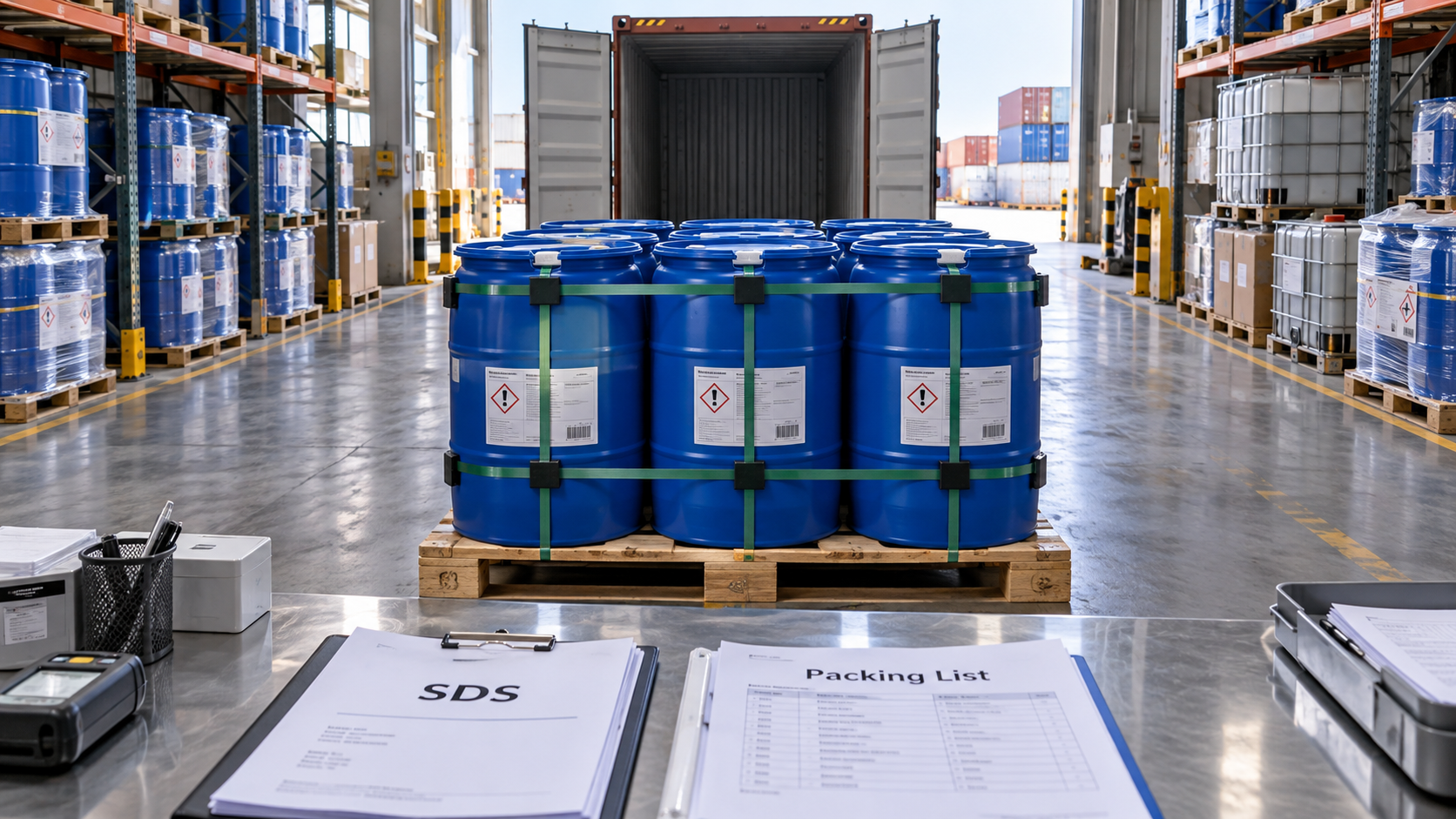
A safety data sheet, or SDS, is an essential starting point, but it is not a universal shipping approval. Confirm that it applies to the exact formulation being purchased, identifies the responsible supplier, and meets applicable language and format requirements. An SDS for a related product or a different concentration can lead to an incorrect booking.
Review the transport information against the proposed mode. Where the product is regulated as dangerous goods, the booking data may need to include the UN number, proper shipping name, hazard class, subsidiary risks, packing group where assigned, and relevant environmental or handling information. These entries must be consistent with the product’s properties and the applicable transport rules.
Sea transport is governed by the applicable International Maritime Dangerous Goods Code requirements, while air transport follows its own dangerous goods framework. Acceptance for one mode does not establish acceptance for another. A product permitted by sea may face different quantity limits, packaging instructions, or operator restrictions by air.
Ask who has checked the classification and what supporting information is available if the carrier challenges it. Depending on the material and shipment, that support may include test results, technical data, or a transport classification assessment. A document issued for a different formulation is not adequate evidence.
“Non-dangerous goods” also does not mean unrestricted cargo. A material may still require moisture protection, temperature control, contamination prevention, or special handling. Import controls and workplace labeling obligations can apply independently of transport classification.
Establish destination eligibility before cargo leaves the factory
Export clearance and import clearance are separate decisions. Successful departure from the country of origin does not establish that the destination will admit the shipment.
Before booking, confirm the intended use and the party legally responsible for importation. Requirements can change when a chemical is sold for industrial processing, food-related use, agriculture, cosmetics, or another regulated application. A material acceptable for one use is not automatically acceptable for another.
The destination review should resolve:
- Whether the substance or mixture is subject to chemical inventory, registration, notification, licensing, or restriction requirements.
- Whether the importer holds the necessary permissions and can provide information needed for clearance.
- Whether labels, packaging, and safety information meet applicable local requirements.
- Whether the proposed tariff classification and customs description are appropriate for the product.
- Whether origin documentation or preferential tariff evidence is required and can be issued correctly.
HS classification deserves particular care for mixtures and formulated products. A supplier’s suggested code is useful input, not a substitute for destination-side review. National tariff subdivisions can differ, and the classification can affect duties, controls, and documentation.
Obtain confirmation from the importer or its appointed customs broker before dispatch when eligibility is uncertain. Leaving this question until arrival converts a regulatory issue into a storage and cash-flow problem.
Require acceptance of the actual packaging and route
“Packed in drums” is not a sufficient packaging specification. Confirm the container material, nominal capacity, fill quantity, closure system, pallet arrangement, and compatibility with the contents. For dangerous goods, verify any required packaging approvals and ensure that the proposed use falls within their conditions.
A UN packaging mark is not a blanket approval for every chemical or filling method. Suitability depends on factors such as chemical compatibility, permitted contents, packing group, density, pressure, and closure instructions. Reused packaging requires particular scrutiny where reuse is permitted.
For moisture-sensitive, corrosive, or high-purity chemicals, packaging can determine whether compliant cargo remains usable on arrival. Liners, seals, and contact surfaces should be evaluated against the product, not chosen solely to reduce packing cost. Wooden pallets and dunnage may also require treatment and marking under applicable destination rules.
Carrier acceptance should cover the actual product, quantity, packaging, and itinerary. A forwarder’s general ability to handle chemicals does not prove that a particular shipping line, airline, terminal, or transshipment port will accept this shipment.
Request clarity on whether acceptance is confirmed or conditional, including outstanding documents and cargo cut-off times. If the route changes, establish whether dangerous goods approval must be obtained again. A replacement sailing is not operationally equivalent if its transshipment point cannot handle the cargo.
Compare the delivered cost, not the headline freight rate
Chemical shipment quotations become misleading when they cover different scopes. One offer may include dangerous goods handling and export documentation; another may quote only the main carriage. Compare them using the same product details, packaging, route, delivery point, and responsibility split.
Not every contingency can be priced in advance. The useful distinction is between fixed charges, estimated charges, and charges triggered by a defined event. Ask for the rate basis, payer, currency, and approval process for additional expenditure.
State the Incoterms® rule, named place or port, and version in the contract. These rules allocate specified delivery obligations, costs, and risk; they do not settle every issue involving product compliance, payment, ownership, or service-provider liability. Under C-terms, for example, the seller may pay carriage to a destination even though risk transfers earlier.
Be especially careful with a delivered-duty-paid offer if the seller has not established a lawful way to complete import formalities. A commercial promise to include duties cannot replace the required importer arrangements.
Test coordination through documents and deadlines
The value of an integrated export provider lies in controlling handoffs between the manufacturer, warehouse, forwarder, customs broker, carrier, and importer. The relevant evidence is a workable shipment plan, not a broad list of services.
Ask who releases the cargo, prepares and signs dangerous goods documents where required, checks customs data, submits shipping instructions, and approves draft transport documents. The provider should also identify which documents depend on the manufacturer or importer and when those inputs are due.
Review the commercial invoice, packing list, certificates, declaration data, and draft bill of lading or air waybill for consistency. Product descriptions need not be identical in every field, but quantities, weights, package counts, batch references, and relevant transport particulars must reconcile.
If payment is under a letter of credit, review its documentary requirements before booking. A requirement for an unavailable certificate, an unsuitable transport document, or an impractical presentation deadline can delay payment even when the cargo moves correctly. Amendments are easier to manage before dispatch than after documents have been issued.
For consolidated orders, check more than the saving in freight. Products must be suitable for co-loading, meet applicable segregation requirements, and be accepted at the same handling facilities. The schedule should also account for the possibility that one supplier’s late batch or incomplete paperwork holds up the entire consignment.
Agree on exceptions before paying to reserve capacity
A booking confirmation does not guarantee departure on the intended sailing, and a quoted transit time does not necessarily include customs release or delivery. Establish the cargo-ready date, documentation deadlines, planned departure, estimated arrival, and the assumptions behind each milestone.
The contract or booking terms should explain what happens if cargo is rejected, misses a cut-off, requires repacking, or must be returned. Agree who authorizes corrective action and how related costs are allocated. Broad assurances that the provider will “handle everything” are difficult to enforce when the cause of a delay is disputed.
Review cargo insurance separately. Check the insured journey, commodity description, packing conditions, exclusions, deductibles, and claims procedure. Do not assume that delay, contamination, leakage, or temperature damage is covered simply because a policy is described as comprehensive.
Booking should proceed when product identity, destination eligibility, packaging, carrier acceptance, document ownership, and cost scope are sufficiently resolved. Conditional bookings can be reasonable where cancellation exposure is understood, but they should not conceal an unresolved legal or safety issue. The strongest offer is the one that makes both the shipment plan and the financial consequences of exceptions clear before cargo moves.
Send Us Your Inquiry Today