
Latest News


Send Us A Message
How to select fungicides when resistance is a field concern
When disease control begins to fail in a field that previously responded well, the immediate temptation is to switch to a stronger rate, shorten the spray interval, or buy a product with a broader label claim. Those actions can increase cost and crop risk without solving the underlying problem. A field-level resistance concern should change the selection process: choose fungicides by mode of action, resistance history, disease biology, and the role the treatment must play in the program—not by product name alone.
The first decision is to determine whether reduced performance is likely to be resistance at all. Poor coverage, delayed application, unsuitable water volume, incorrect disease diagnosis, weather-driven disease pressure, degraded product, or an incompatible tank mix can resemble resistance. Once those factors have been checked, fungicide selection should favor an effective, unrelated mode of action and a program that reduces further selection pressure. The objective is not merely to recover one spray interval; it is to preserve useful chemistry for the remaining crop cycle.
Start with the field failure pattern
Resistance rarely presents as a simple “product worked” versus “product failed” event. Technical evaluators should document how the failure appeared across the field and compare it with the application record. A uniform loss of control after repeated use of the same fungicide group is more concerning than isolated patches near field edges, compacted areas, or zones where canopy penetration was poor.
Before changing products, review the following points:
- Disease identity: Confirm the pathogen or disease complex. Foliar symptoms, root disorders, bacterial diseases, nutrient stress, and herbicide injury may overlap visually.
- Timing: Determine whether spraying occurred before infection, near first symptoms, or after the disease was established. Many fungicides are most dependable when used protectively or at very early infection stages.
- Application quality: Check nozzle choice, droplet spectrum, spray volume, operating pressure, travel speed, canopy density, and whether both leaf surfaces or fruiting zones were adequately reached.
- Weather around application: Rainfastness, wash-off, leaf wetness duration, temperature, and rapid crop growth can all change apparent field performance.
- Use history: Record active ingredients and Fungicide Resistance Action Committee (FRAC) group codes used in the current and previous seasons, including seed treatments and premixes.
- Expected disease pressure: High inoculum, susceptible varieties, repeated irrigation events, or dense canopy conditions can exceed the practical capacity of a normally effective spray program.
A suspected resistance issue becomes more credible when the target disease is correctly identified, application quality was sound, use was timely, and control has weakened after repeated exposure to the same FRAC group. Even then, resistance can vary within a field. A useful selection decision should assume that sensitive and less-sensitive pathogen populations may coexist.
Use mode of action as the primary filter
Product labels often emphasize crops, diseases, and formulation benefits. For resistance management, the more important technical question is: which biochemical target is the active ingredient affecting? FRAC group codes provide a practical way to distinguish modes of action and identify cross-resistance risks.
Do not treat different active ingredients as automatically different resistance tools. Two products may have different chemical names yet belong to the same FRAC group and act at the same target site. In that situation, replacing one with the other may provide little benefit where reduced sensitivity has already developed. This is particularly important for single-site fungicides, which tend to carry a higher resistance risk than multisite contact materials.
In practical terms, a field with suspected failure from one single-site group should not be rescued by repeatedly applying another formulation dominated by the same group. Select a registered alternative with activity against the confirmed disease and an unrelated FRAC code. Where the label and crop conditions permit, combine it with a multisite protectant or another effective partner from a different group. The goal is to reduce the chance that surviving individuals are selected again by the same biochemical pressure.
Do not confuse a premix with a resistance-management program
Premixes can be valuable, but not every two-active product is equally useful when resistance is already suspected. A mixture works best when both active ingredients have reliable activity against the target pathogen, have different modes of action, and are applied at rates that provide meaningful field performance. If one partner is already compromised, the other component may effectively be used alone, even though the label lists two modes of action.
Review the field history against each component, not just the premix name. For example, if a grower has applied one active ingredient through several branded products, then introduces a premix containing that same active ingredient, the prior selection pressure remains relevant. A technical evaluation should map active ingredients by FRAC group across all applications.
There is also a timing issue. A highly systemic product may offer redistribution within plant tissue, while a contact protectant remains on the surface where it is deposited. Their value depends on disease location, canopy growth, rainfall exposure, and whether new tissue is emerging rapidly. A mixture cannot correct poor coverage in a dense crop canopy, nor can it restore tissue that has already been severely colonized.
Match the alternative to the disease and crop stage
Once an unrelated mode of action has been identified, the next question is whether it fits the actual disease situation. Broad-spectrum claims are not enough. Different pathogens differ in their infection cycle, spore production, tissue preference, and speed of epidemic development. A product effective against one leaf spot disease may not be the right choice for powdery mildew, downy mildew, botrytis-type diseases, soilborne pathogens, or oomycetes.
Crop stage also changes the decision. Early vegetative protection may prioritize keeping new foliage covered. During flowering or fruit set, the disease-risk period and residue requirements may narrow the acceptable options. Near harvest, pre-harvest interval, maximum seasonal use limits, and market residue requirements can become decisive. A technically sound alternative that cannot be legally applied at the intended crop stage is not an operational option.
Protectant, locally systemic, and systemic behavior
Fungicides are often described according to how they move or remain on the plant. This behavior affects selection, but it should not be mistaken for a guarantee of control.
- Contact protectants remain largely on treated surfaces and can be useful for preventing infection. They depend heavily on thorough coverage and may need renewal as foliage expands or weather removes deposits.
- Locally systemic or translaminar products may move through treated tissue or from one leaf surface to the other. They can improve protection where direct deposition is difficult, but their disease spectrum remains specific.
- Systemic products move within plant tissues to varying degrees. They may provide flexibility in timing, yet resistance risk can be high for certain single-site groups, and post-infection activity has limits.
A resistance-management choice should therefore combine biological fit with placement strategy. In a fast-growing canopy, a contact-only approach may leave untreated new tissue exposed. In a disease situation with established lesions, relying on protectant chemistry alone may be inadequate. The correct response may involve an unrelated systemic or translaminar group, appropriate coverage, and a protectant partner where approved—not simply increasing the dose of the previous product.
Build the remaining spray sequence, not just the next application
Resistance management fails when each spray is chosen in isolation. After a suspected field failure, map the remaining disease-risk period and assign FRAC groups to each planned application. This reveals accidental repetition that is easy to miss when products are purchased from different suppliers or used across multiple crop blocks.
For the remainder of the season, avoid consecutive applications from the same group unless the label specifically allows a limited sequence and no effective alternative exists. Even where two applications are permitted, repeated use should be justified by disease pressure and followed by a genuinely unrelated group. Consider seasonal application limits as part of resistance stewardship, not merely as a label compliance detail.
Intervals should follow disease pressure, crop growth, product persistence, and label directions. Shortening intervals without changing mode of action can intensify selection pressure. Conversely, extending intervals too far during wet, favorable conditions can leave gaps in protection and create the impression that a product is ineffective. The right interval is a risk-management decision, not a fixed calendar habit.
Check formulation and compatibility before approving a purchase
Technical selection is incomplete until the proposed product can be safely and consistently used in the local spray program. The same active ingredient may be supplied in different formulations, such as suspension concentrates, wettable granules, water-dispersible granules, emulsifiable concentrates, or soluble concentrates. Formulation affects handling, dispersion, dust exposure, tank-mix behavior, storage needs, and suitability for the available equipment.
Evaluate whether the formulation can be mixed with intended adjuvants, foliar nutrients, insecticides, or other crop-protection products. A jar test can identify obvious physical incompatibility, but it does not replace label instructions or a full phytotoxicity assessment. pH-sensitive products, hard water, highly alkaline water, and improper mixing order may reduce stability or create spray tank problems. In a resistance situation, a failed tank mix can be wrongly blamed on pathogen resistance and lead to an unnecessary chemistry change.
Also verify that the selected formulation is appropriate for the application method. Air-assisted orchard equipment, field boom sprayers, aerial application, greenhouse systems, and handheld equipment differ in coverage pattern and drift risk. Label-approved application methods, re-entry requirements, personal protective equipment, and crop-specific restrictions must remain part of the selection decision.
Regulatory and supply checks that affect technical usability
For international procurement, a fungicide can be technically suitable yet unusable if documentation, registration status, labeling, or transport classification is incomplete. Confirm that the active ingredient, formulation, concentration, and intended use are permitted in the destination market. Do not assume that a product registered in one country can be imported, repacked, or applied in another.
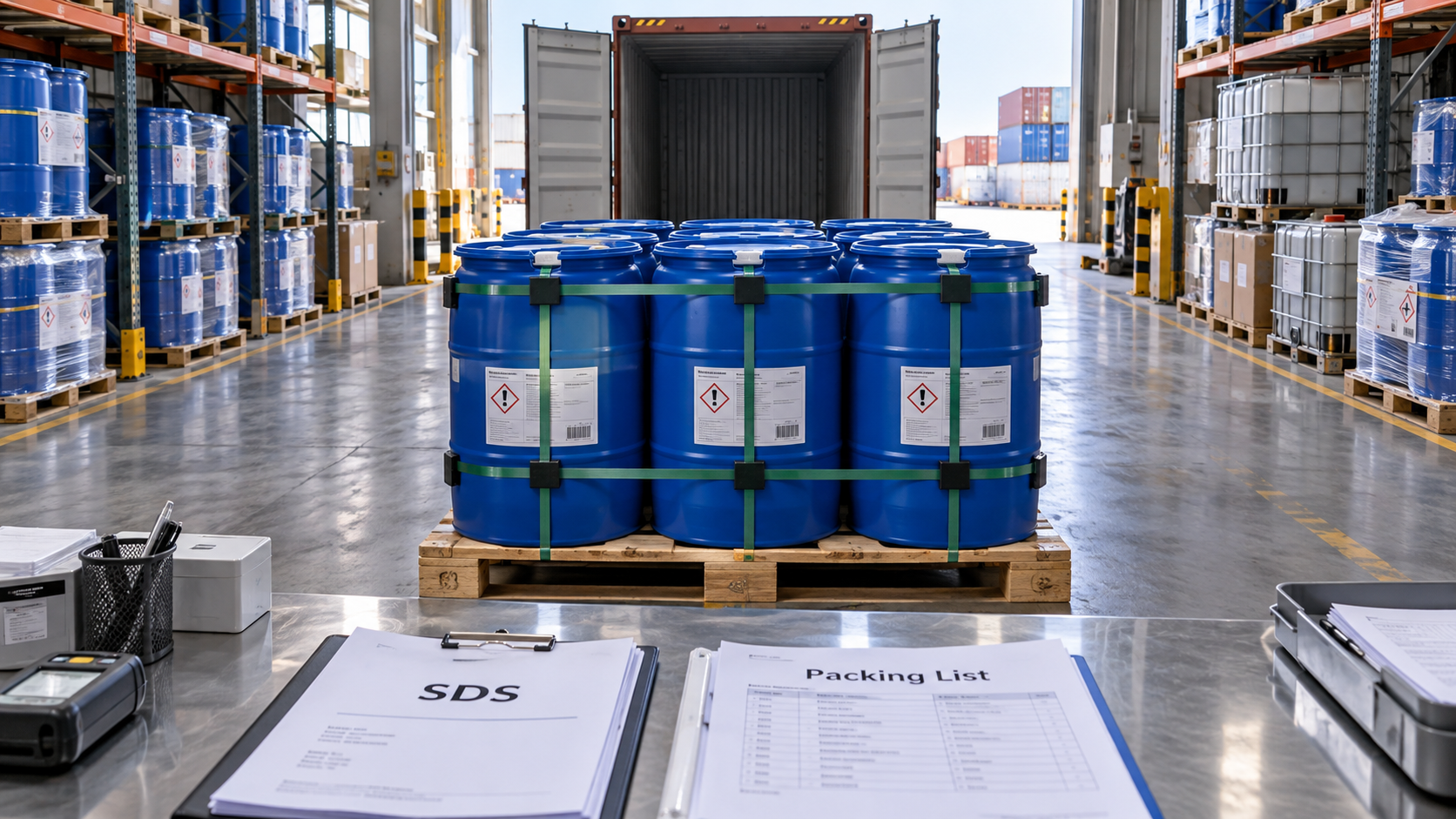
Before approving a supplier or shipment, request documents that allow the material to be evaluated against the purchase specification and local requirements. Depending on the product and market, this may include a certificate of analysis, safety data sheet, technical data sheet, batch identification, packing details, transport information, and documents supporting customs clearance. The label language, hazard communication, packaging format, and shelf-life conditions should match the planned distribution and storage environment.
Batch consistency matters because application rates and tank-mix decisions depend on the stated concentration and formulation quality. Procurement teams should define acceptable active ingredient content, physical properties relevant to the formulation, packaging integrity, and document requirements before shipment. For hazardous chemical exports, logistics planning should also account for classification, packaging standards, port handling, and destination restrictions. These are operational controls, not administrative extras; a delayed or non-compliant shipment can disrupt an otherwise well-designed disease program.
When laboratory confirmation is worth pursuing
Field observations can guide an immediate response, but they do not always prove resistance. Laboratory sensitivity testing or specialist diagnostic support is most valuable when a high-value crop faces repeated unexplained failures, when the disease identity is uncertain, when a major fungicide group may need to be removed from the program, or when local resistance history is poorly understood.
Collect samples from active disease margins rather than from fully decayed tissue, keep samples identifiable by field and treatment history, and avoid combining material from unrelated blocks. The most useful submission includes crop stage, symptoms, product history by active ingredient, application timing, rates, weather conditions, and photographs of the distribution pattern. This information helps distinguish resistant pathogen populations from application or diagnosis problems.
A sound selection decision under resistance pressure is therefore evidence-based and sequential: verify the failure, identify recent FRAC exposure, choose an effective unrelated mode of action, use mixtures only when both partners contribute, and plan the rest of the spray program before placing the next order. That approach protects crop performance while reducing the likelihood that the replacement fungicide becomes the next product to lose effectiveness.
Send Us Your Inquiry Today