
Latest News
Send Us A Message
Rutile vs. Anatase Titanium Dioxide: Which Suits Exterior Coatings?
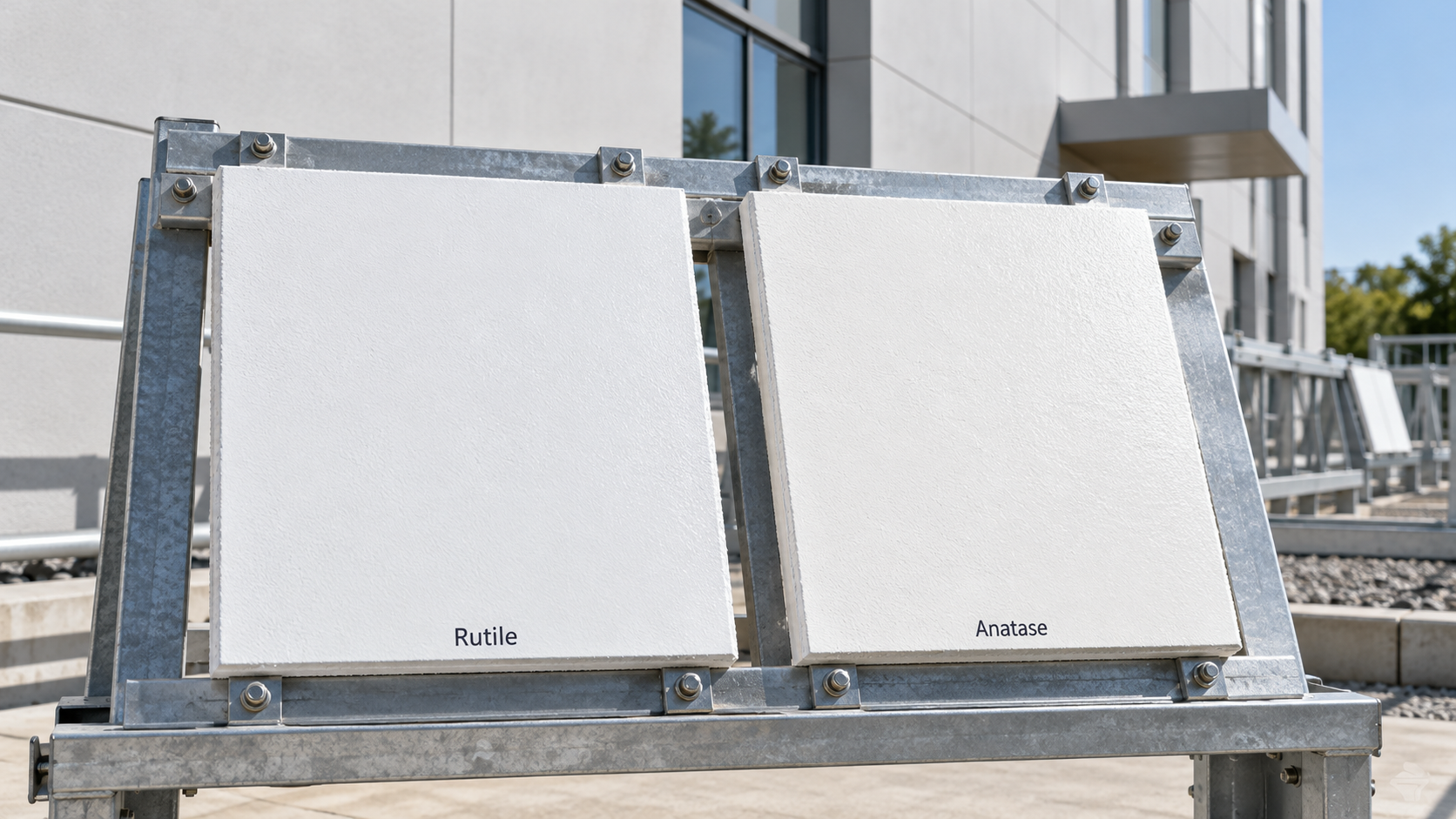
For most exterior coatings, surface-treated rutile titanium dioxide is the preferred starting point. It generally provides stronger hiding power and better resistance to sunlight-driven binder degradation than anatase. Those advantages help a coating retain its appearance and protective film during outdoor exposure.
However, “rutile” alone is not a sufficient purchasing specification. An inadequately protected rutile grade can still contribute to chalking, while a pigment with poor dispersion can deliver disappointing opacity despite favorable supplier data. The practical decision is therefore two-stage: select the appropriate crystal form, then qualify a grade for the binder, finish, exposure conditions, and expected service life.
Why rutile usually performs better outdoors
Rutile and anatase are crystal forms of titanium dioxide, often abbreviated as TiO₂. They share the same chemical composition, but their different crystal structures affect how they scatter light and interact with ultraviolet radiation.
Rutile has a higher refractive index than anatase. In a properly formulated coating, this generally gives it greater potential to scatter visible light and hide the substrate. That can support better coverage at a given film thickness, although the result also depends on particle distribution, dispersion, and the surrounding formulation.
The more consequential difference outdoors is photochemical behavior. Under UV exposure, titanium dioxide can generate reactive species that attack nearby organic material, including the coating binder. Anatase generally shows higher photocatalytic activity, making it a less suitable default for conventional exterior paints that depend on preserving an organic film.
As the binder deteriorates, pigment and extender particles become exposed at the surface. The coating can lose gloss, change appearance, and develop a loose powder commonly described as chalking. Rutile generally presents a lower photocatalytic risk, particularly when its surface has been treated for exterior durability.
This does not mean rutile prevents all weathering. Moisture, temperature cycling, binder chemistry, formulation balance, and application conditions also influence coating failure. It means that an exterior-grade rutile pigment usually removes one avoidable source of stress from the system.
Surface treatment separates suitable exterior grades from unsuitable ones
Commercial pigment particles are often coated with inorganic materials such as silica and alumina, sometimes combined with organic treatments. These treatments influence different aspects of performance, so a statement such as “surface treated” needs more detail to support a selection.
For exterior durability, an important purpose of the inorganic treatment is to limit contact between the photoactive pigment surface and the surrounding binder. The effectiveness depends on the treatment’s composition, coverage, and structure. A higher treatment content does not automatically establish better performance.
Surface chemistry also affects wetting, dispersion, and interactions with other formulation ingredients. A grade that disperses readily in a solventborne system may behave differently in a waterborne acrylic paint. Organic treatments can improve handling or compatibility, but they do not replace the need for appropriate protection against photochemical activity.
For a shortlist, request a clear description of the intended application, treatment chemistry, and available weathering evidence. “General-purpose rutile” provides less useful guidance than a grade positioned for exterior coatings with supporting formulation data.
The manufacturing route is another incomplete shortcut. Both sulfate-route and chloride-route rutile pigments can be suitable for exterior use. Process route may influence product characteristics, but it should not replace assessment of the finished pigment’s surface treatment, dispersion behavior, and durability.
Hiding power must be assessed inside the formulation
Rutile’s optical advantage is valuable only when the formulation allows the pigment to scatter light efficiently. Agglomeration, unsuitable particle spacing, and poor dispersion can reduce the benefit. Adding more TiO₂ may then increase cost without producing a proportional improvement in coverage.
This becomes especially relevant when comparing pigments by purchase price. A lower-priced grade may require more pigment, additional dispersant, or longer processing to reach the same finish. A more expensive grade may be economical if it meets the required opacity at a lower loading, but that saving must be demonstrated in the intended formulation.
Compare cost at the required coating performance, not simply cost per kilogram of pigment. Useful reference points include hiding at the specified dry film thickness, acceptable application viscosity, and the amount of coating needed to achieve coverage.
Whiteness also needs careful interpretation. A visually attractive blue undertone does not prove better hiding or weatherability. In tinted coatings, changing pigment grades can alter tint strength and undertone enough to require colorant adjustments. Evaluate white and representative tinted versions when both form part of the product range.
The binder and finish change which rutile grade makes sense
A durable pigment cannot compensate for a binder that is unsuitable for the exposure. At the same time, a weather-resistant binder can lose performance if the pigment encourages degradation or disrupts film formation. Pigment qualification therefore belongs within the complete coating system.
Exterior acrylic wall paints
For waterborne acrylic coatings, examine dispersion stability, viscosity development, and compatibility with the dispersant package. A pigment can appear satisfactory immediately after manufacture yet develop settling, flocculation, or viscosity drift during storage.
In flat masonry paints, pigment volume concentration also matters. As the formulation approaches or exceeds its critical pigment volume concentration, insufficient binder and increased porosity can become major limitations. Changing from anatase to rutile will not correct a film whose overall formulation cannot withstand its exposure.
Gloss finishes and industrial coatings
Gloss coatings are sensitive to agglomerates and surface irregularities. A pigment may provide good opacity while limiting gloss or producing visible texture. Assess dispersion quality alongside hiding, initial gloss, and gloss retention after weathering.
For metal coatings, evaluate the complete system’s adhesion and corrosion performance as well. TiO₂ contributes opacity and appearance, but it is not a substitute for corrosion-control pigments, suitable pretreatment, or an effective barrier film.
Clearcoats and transparent finishes
Conventional pigmentary titanium dioxide is designed to scatter visible light, so it is generally unsuitable where transparency is essential. A clear exterior coating requires a different approach to UV protection. Specifications for transparent UV-screening materials should not be treated as interchangeable with those for white hiding pigments.
When could anatase be a reasonable choice?
Anatase can make sense in applications where its optical characteristics, formulation behavior, or economics are useful and exposure requirements allow it. That may include selected interior coatings or other applications with limited weathering demands.
A sheltered exterior location can reduce exposure, but shelter alone is a weak basis for substitution. Reflected sunlight, wind-driven rain, and different building orientations can create uneven aging. A formulation accepted under a deep overhang may perform differently on an exposed elevation.
Photocatalytic coatings are a separate case. Some specialized surfaces deliberately use photoactivity to support functions such as degradation of organic contamination. In that situation, the coating must be designed around the intended activity, including the resistance of its binder or supporting matrix.
This is a different design objective from preserving a conventional organic paint film. Substituting anatase into an ordinary exterior paint does not, by itself, create a durable self-cleaning coating.
How to compare supplier samples without misleading results
A useful evaluation distinguishes simple substitution from formulation optimization. Begin with a controlled comparison in the existing formulation to identify immediate compatibility problems. Then optimize promising candidates within the normal formulation limits to assess what each grade can realistically deliver.
Replacing pigments at equal weight is convenient for screening, but differences in density and treatment content can change pigment volume. For a more rigorous comparison, control pigment volume concentration and film thickness. Record any changes in dispersant demand, processing conditions, and application viscosity.
- Set the exposure target. Define the substrate, binder, finish, application method, and expected sunlight and moisture conditions.
- Establish initial film performance. Measure hiding, color, gloss where relevant, and film uniformity at controlled dry film thickness.
- Check processing and storage behavior. Assess dispersion, viscosity stability, settling, and compatibility with the complete formulation.
- Compare weathering behavior. Track chalking, gloss loss, color change, cracking, and relevant adhesion changes against an established exterior-grade control.
- Review total formulation cost. Include pigment loading, dispersant demand, processing effort, and the coverage needed to meet the specification.
Accelerated weathering helps screen candidates, but test conditions influence the ranking. UV source, moisture cycles, temperature, and evaluation methods should be comparable across samples. Results from different procedures should not be placed side by side as though they were equivalent.
Natural exposure provides complementary evidence, especially for demanding service conditions. An accelerated test result should not be converted directly into a guaranteed number of outdoor service years.
Turn the preferred grade into a clear purchasing specification
Once a candidate performs well, purchasing documents should identify more than crystal form and TiO₂ content. High purity alone does not establish exterior durability; protective surface treatments contribute to grade performance while reducing the proportion reported as titanium dioxide.
Specify the producer and grade designation, intended exterior application, agreed quality limits, packaging, and batch documentation. A technical data sheet describes typical properties, while a certificate of analysis reports the batch results covered by the supplier’s release checks. Neither replaces qualification in the finished coating.
Require notice of changes that could affect performance, including changes to the producer, surface treatment, or grade identity. Two products described as “equivalent rutile” may differ enough in dispersion or weathering behavior to require separate approval.
For international procurement, Jingruiyake’s supplier coordination, export documentation, and logistics services can support sourcing after the technical requirements are defined. A useful inquiry should include the binder system, finish, exposure conditions, current performance benchmark, and sample evaluation criteria. This gives the procurement partner a practical basis for matching candidates.
For a conventional exterior coating, start with surface-treated rutile intended for outdoor durability. Approve the specific grade only after it delivers the required hiding, processing behavior, and weathering performance in the actual formulation. That sequence makes the crystal-form decision useful without allowing it to stand in for the rest of the evaluation.
Send Us Your Inquiry Today