
Latest News


Send Us A Message
Are crop protection products shifting toward lower-residue options
Are Crop Protection Products Shifting Toward Lower-Residue Options?
Crop Protection Products are moving toward lower-residue options, but the shift is not as simple as replacing one active ingredient with another. For growers, food exporters, distributors, and chemical buyers, the real issue is whether a treatment program can control pests and diseases while fitting the residue expectations of a particular crop, market, and buyer.
That distinction matters. A product may be legally registered for use in the producing country and still create commercial risk if the harvested crop is destined for a market with a different maximum residue limit, or MRL. The concern becomes even sharper for fresh fruit, vegetables, tea, herbs, spices, and other products that face repeated residue monitoring before shipment or at destination.
The market direction is clear: residue management is becoming part of crop protection planning, not merely a laboratory check performed after harvest. Yet “lower residue” should not be treated as a marketing label. It can refer to a shorter pre-harvest interval, a residue profile that declines more quickly under intended use conditions, a lower application rate, a biological or microbial alternative, or simply a better-timed treatment plan. These are not interchangeable ideas, and procurement teams that treat them as interchangeable often discover the difference too late.
Why the Residue Conversation Has Moved Up the Supply Chain
For years, pesticide selection was frequently driven by field efficacy, price per hectare, and availability during the season. Those factors remain important. No buyer wants a lower-residue option that fails to control a fast-moving infestation or allows a fungal disease to spread through a commercial crop. What has changed is that downstream requirements now influence decisions much earlier: before a distributor imports material, before an exporter books cargo, and ideally before growers begin their spray schedule.
Food retailers, processors, importers, and brand owners increasingly apply their own purchasing specifications in addition to official requirements. In practice, a grower or exporter may need to consider the destination country’s MRLs, the buyer’s internal residue policy, the intended harvest date, and the analytical methods likely to be used in testing. A treatment that is acceptable for domestic wholesale channels may not be suitable for a premium export program.
The pressure is especially visible in supply chains where crops from many small farms are consolidated. One lot with an unexpected result can complicate an entire shipment. This is why residue risk is no longer solely an agronomy topic. It is a commercial, documentation, and logistics issue as well.
Chemical buyers are responding by looking beyond a single product quotation. They ask whether the formulation is consistent, whether batch traceability is available, whether labels and technical documents align with the intended market, and whether supply can be maintained through the critical treatment window. These questions may feel operational, but they determine whether a lower-residue strategy is workable outside a trial plot.
What “Lower Residue” Actually Means in Commercial Use
There is no universal category called “lower-residue crop protection.” Residues depend on the active substance, formulation, dose, number of applications, spray coverage, crop type, weather, plant growth stage, interval before harvest, and local use pattern. A product that performs well in one crop and climate may require a different assessment in another.
The most useful way to think about the trend is through risk management. Buyers are seeking programs that reduce the likelihood of unacceptable residues without leaving growers exposed to preventable pest pressure. This often leads to a more varied toolbox rather than a wholesale move away from conventional chemistry.
- Targeted conventional products may remain essential where efficacy, resistance management, or disease pressure requires them, but timing and permitted use patterns receive closer attention.
- Biologicals and biopesticides are being considered more often, particularly in late-season programs or integrated pest management plans. Their suitability still depends on crop conditions, storage requirements, application discipline, and local registration status.
- Adjuvants, pheromones, traps, and non-chemical measures can reduce reliance on repeated broad-spectrum treatments, although they may not replace direct intervention during severe outbreaks.
- Improved application management—including calibrated equipment, water quality control, rotation planning, and accurate records—can be as important as changing the product itself.
A common mistake is to assume that “natural” automatically means residue-free or commercially uncomplicated. Biological materials can have handling sensitivities, shorter shelf-life considerations, and performance limitations under certain field conditions. Conversely, an established chemical product can sometimes fit a residue-conscious program when used strictly according to the relevant label and local agricultural guidance. The decision should be based on the specific crop-market route, not on broad product labels.
Export Markets Are Making Product Selection More Specific
The same crop may be sold into Southeast Asia, the Middle East, Europe, the Americas, or Africa, but the commercial acceptance criteria can differ substantially. Regulations change over time, buyer specifications may be stricter than statutory requirements, and importing countries may have different expectations for products without an established local tolerance. It is risky to rely on an assumption that a product acceptable in one destination will be accepted everywhere.
For decision-makers, this means the correct question is not, “Which product has the lowest residue?” A better question is, “Which crop protection program can be supported by the intended use pattern, harvest schedule, destination requirements, and available technical documentation?” That framing brings agronomy and trade into the same conversation.
A buyer sourcing materials for distribution should also distinguish between a product’s technical specification and its regulatory usability. A certificate of analysis may confirm the quality of a supplied batch, but it does not by itself establish that the product is registered, permitted, or appropriate for a specific use in the country of application. Similarly, a safety data sheet is necessary for transport and workplace handling, yet it is not a substitute for local product-registration review.
That separation is easy to overlook when purchasing is driven by urgent seasonal demand. It becomes painfully visible when labels, shipping documents, customs classification, and end-market requirements do not match the original procurement plan.
The Procurement Trade-Off: Better Residue Control Without Supply Disruption
Lower-residue strategies often create a more complex sourcing brief. Instead of ordering one familiar active ingredient in large volume, a distributor may need several complementary products, different formulation types, or smaller batches timed around crop seasons. This can increase coordination work even where the overall program is commercially sensible.
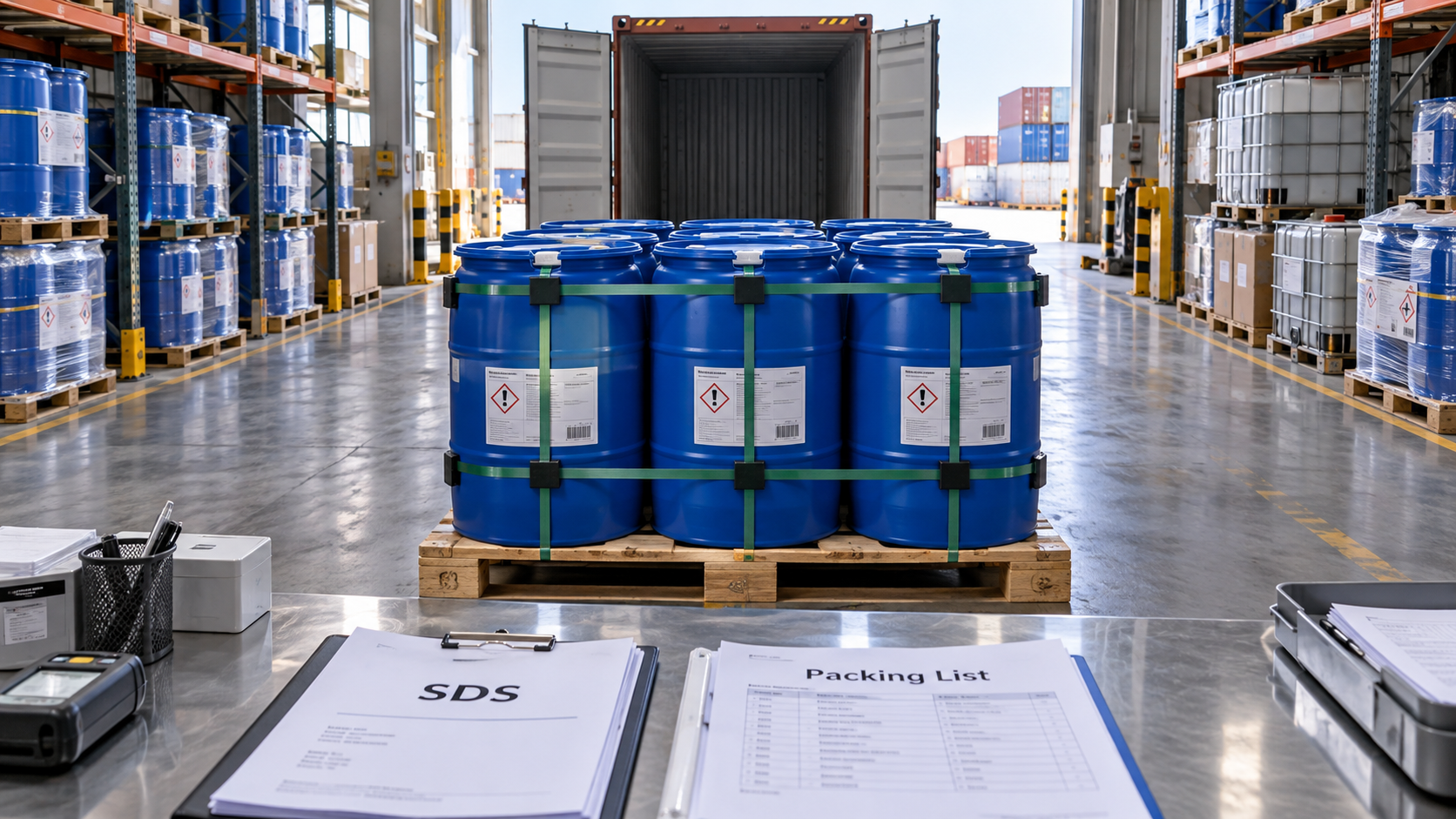
Supply reliability becomes part of the technical decision. If a replacement product arrives after the relevant pest window has passed, its residue advantage offers little value. If packaging is unsuitable for the local distribution model, relabeling or repacking can introduce delays and compliance questions. If the material is subject to hazardous-goods transport controls, booking space and preparing compliant documentation may require more lead time than buyers expect.
This is one reason experienced importers increasingly evaluate chemical suppliers and trading partners on more than quoted price. They need product knowledge, responsive coordination, clear batch records, and the ability to manage the export process without treating documentation as an afterthought. In international chemical trade, a missing or inconsistent document can stop a shipment just as effectively as a manufacturing issue.
For companies sourcing from China, access to multiple chemical-producing regions can be useful when a single factory cannot meet every requirement on formulation, quantity, packaging, or delivery timing. A trading company with practical knowledge of chemical export procedures can help consolidate procurement across suppliers, provided that quality consistency and documentation are checked product by product rather than assumed across a portfolio.
Jingrui Yake operates in this part of the value chain, supporting international chemical procurement and export coordination across a range of product categories and shipment requirements. Its role is not simply to move goods from port to port. For buyers dealing with crop protection-related chemicals, the more relevant value lies in coordinating inquiries, contracts, order progress, booking, customs declaration, shipping documentation, and payment processes while recognizing that hazardous materials and destination-specific clearance requirements need careful handling.
Questions That Should Be Asked Before Changing a Product Program
A lower-residue transition should start with a disciplined review, not a catalog search. The following questions tend to reveal whether a proposed option is commercially realistic:
- What crop, target pest or disease, and growth stage is the product intended to address?
- Where will the crop ultimately be sold, and are there customer-specific residue expectations beyond the destination market’s legal requirements?
- What is the actual interval between the planned application and harvest?
- Does the proposed product fit local registration, labeling, and use requirements?
- Can the supplier provide the documents needed for quality review, transport, customs, and internal traceability?
- Are storage, hazardous-goods classification, packaging, and shipping lead times compatible with the seasonal plan?
The answers will not always point to the newest or lowest-priced option. Sometimes the right decision is to retain a proven product earlier in the season and introduce a different intervention closer to harvest. In other situations, the main improvement is not a product replacement at all, but stronger grower instructions and better application records. A residue-management program is only as dependable as its field execution.
Documentation Is Becoming a Commercial Asset
As chemical trade becomes more compliance-driven, documentation is moving from the administrative side of purchasing to the center of supplier evaluation. Buyers commonly need to review product specifications, safety information, packing details, transport declarations where applicable, origin-related documents, and shipment paperwork. Requirements vary by product and destination, so a standard document pack should never be accepted blindly.
For credit-based transactions, the ability to review Letter of Credit terms carefully also matters. Small discrepancies between an L/C, commercial invoice, packing list, bill of lading, or certificate wording can create avoidable settlement issues. This may seem distant from residue management, but it is part of the same commercial reality: a product program only works when the material, the paper trail, and the delivery plan all hold together.
Companies such as Jingrui Yake, which work across supplier sourcing, export documentation, logistics coordination, and payment settlement, can be particularly relevant when buyers are consolidating different chemical requirements into one procurement flow. The practical benefit is reduced coordination burden, not an automatic guarantee of market approval. Registration status, local use restrictions, and residue suitability still need to be verified for each intended application.
A Direction of Travel, Not a One-Product Revolution
Crop Protection Products are indeed shifting toward lower-residue options, especially in export-oriented food chains. But the market is evolving through more selective chemistry, biological additions, integrated pest management, tighter records, and closer coordination between growers and buyers—not through a simple abandonment of conventional products.
The most resilient purchasing decisions will be those that connect crop protection performance with destination-market access and supply-chain execution. Before changing a product line, confirm the use scenario, local regulatory position, documentation package, transport conditions, and realistic delivery window. In this market, the strongest option is rarely the one with the most attractive label claim. It is the one that can be used correctly, documented clearly, supplied consistently, and accepted by the market the crop is actually intended to reach.
Send Us Your Inquiry Today